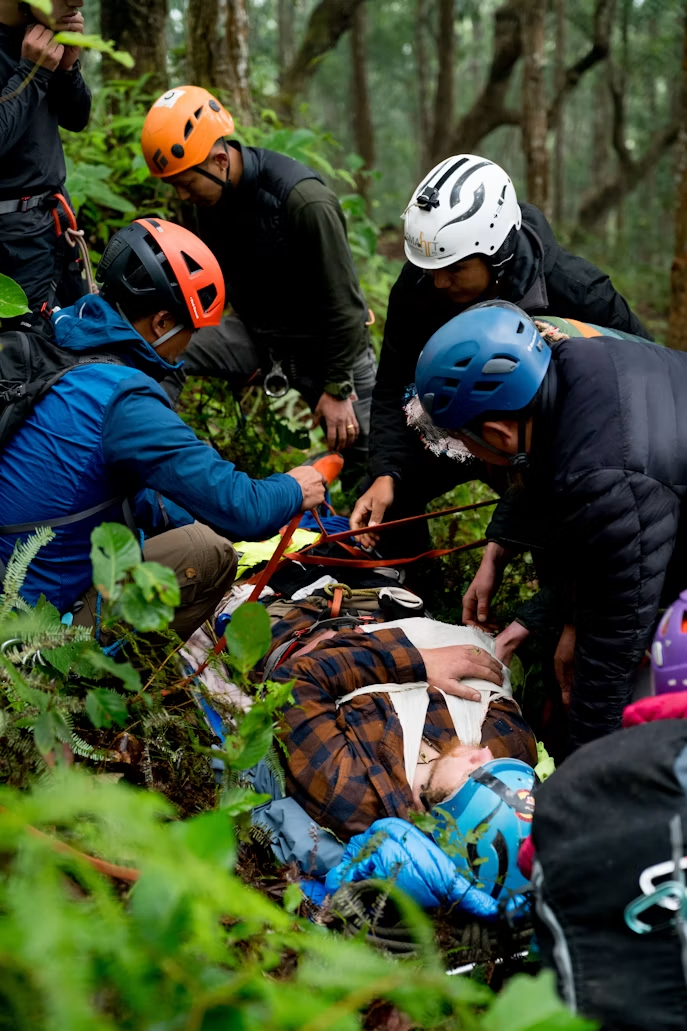
One of the things that really stuck with me from my Wilderness First Responder (WFR) course isn't a skill. It's a moment on day three when the instructor stopped a scenario and asked what my plan was for the next six hours. Not the next six minutes, six hours.
That question compresses the whole course into one line. In town, first aid is a bridge you hold for the eight or ten minutes it takes for an ambulance to arrive. In the backcountry, you're the care.
This post is about why that training is worth the multiple days it takes to get certified, and why the card in your wallet is only the beginning of the work rather than the end of it.
Help is measured in hours
A ten-year review of Search and Rescue (SAR) in Yosemite National Park found that the average time from the call reaching the SAR team to a rescuer arriving on scene was 3 hours and 6 minutes. From notification to the patient reaching definitive care, the average was 5 hours. That's one of the most resourced, most practiced rescue programs in the country, working in a park with helicopters, roads, and a medical clinic in the valley.
Now picture a drainage two days from a trailhead, a hunting camp at the end of forty miles of forest road, or a ski tour where the weather closed the window for flying. The standards body for wilderness medicine education describes the situation plainly: graduates of this training often care for patients for prolonged periods because medical and rescue support is delayed, and they frequently have to make the call on whether and how urgently to evacuate without anyone more qualified to ask.
In the backcountry, definitive care is further away and the environment is much less forgiving. Help isn't late, it's more complex.
If the gap between injury and definitive care is measured in hours, then somebody is going to fill those hours. That means an important question worth answering before you leave is whether that person knows what they're doing.
Who this training is actually for
There's a common assumption that wilderness medicine is only for professionals. Something guides and SAR volunteers carry the way they carry a radio and a rope. A Wilderness First Responder certification is the outdoor industry's standard credential for guides, instructors, and outdoor leaders. But those same professionals and guides recommend it for recreational adventurers on remote multi-day trips or in higher-risk activities, which describes a lot of us on most weekends.
Most of what the training gives you gets used on ordinary days, on problems that never become emergencies or a rescue. You learn to tell a stable ankle from an unstable one, which decides whether your partner walks out tonight or waits for a litter. You learn what a headache at 12,000 feet is telling you, and that going down is a treatment. You learn how to clean a wound well enough that it doesn't turn into a systemic infection three days later, and you learn to recognize when it already has.
You also learn to do very little when very little is correct. A trained person is able to watch a patient carefully for an hour and decide if the group should keep going, self-rescue, or call for help.
All of these skills work in both directions. The person you're most likely to treat is your climbing partner, your hunting buddy, or whoever else is there with you. The person most likely to treat you is that same group. One person with medical training in a party of four helps everyone in it.
The patient might not be in your party
On a busy trail, or at a remote alpine lake, the responder is whoever happens to be standing there or first on scene, and that very well could be you. It's a stranger's group, a stranger's worst day, and you're the closest thing to medical care within a few hours' walk.
Training changes what you can offer in that moment. It also changes what you can hand off. A medic arriving on scene, or a dispatcher hearing you over a radio or a satellite messenger, gets a completely different picture from a person who can report age, mechanism of injury, and vital sign changes, compared to a person who can only say that someone fell and looks bad. That report shapes what gets sent and how fast.
The legal question often comes up when talking about helping someone you don't know, so here's the short version. All fifty US states and the District of Columbia have Good Samaritan laws. Their general purpose is to protect a person who voluntarily helps in an emergency, in good faith, without expecting payment. Protection usually doesn't extend to gross negligence, and some states tie it to acting within the scope of your training. There's also a practical rule the courses teach: if the patient is awake and able to answer, ask for permission before you touch them. Consent is assumed only when someone can't give it. We aren't lawyers and this isn't legal advice, so be sure to look up your own state's statute.
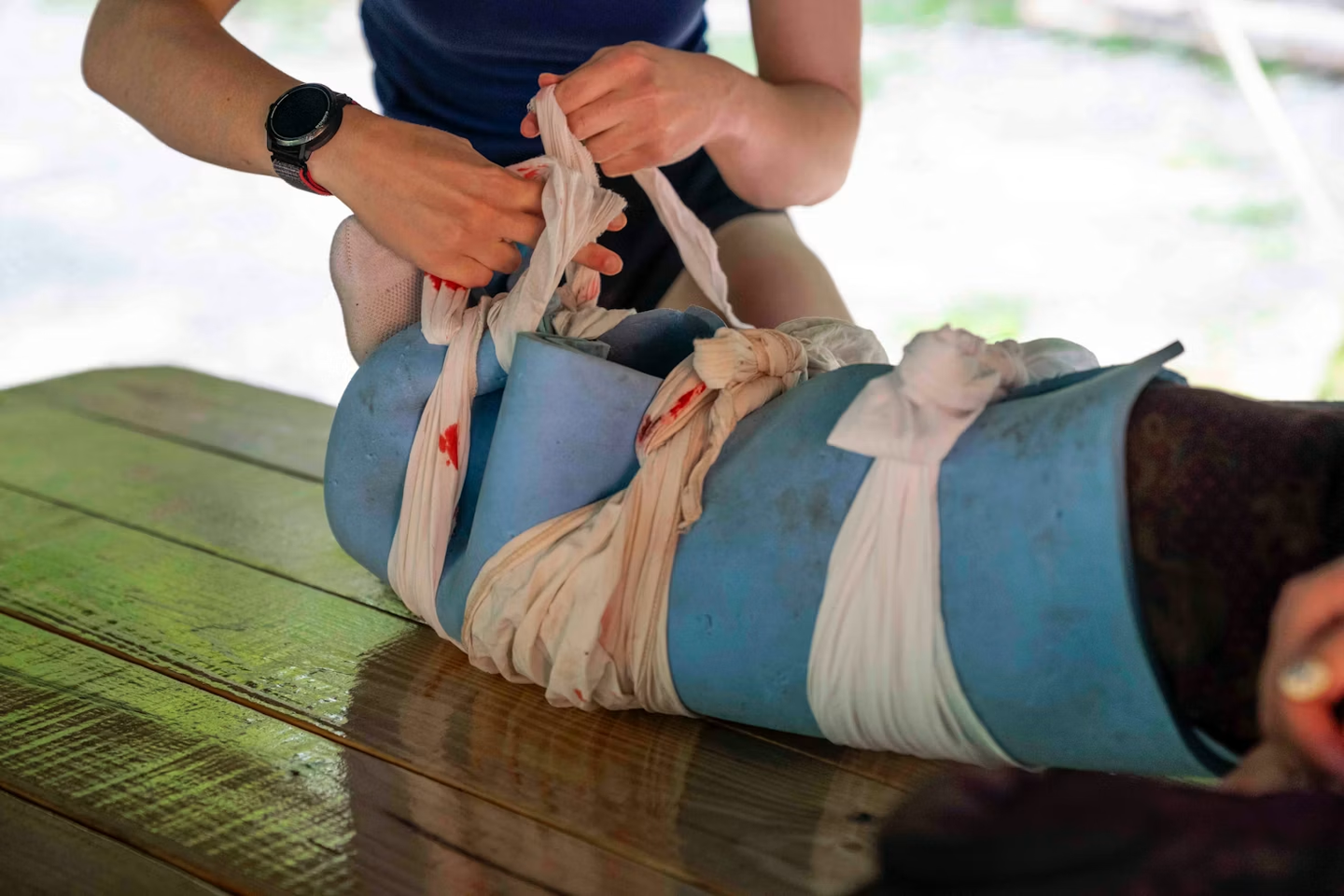
Improvisation is most of backcountry medicine. The splint you build is made from what you already carried.
The certification levels
Wilderness medicine has no federal licensing body, so the curriculum standards come from a consensus group of the schools themselves called the Wilderness Medicine Education Collaborative. Their standards documents set minimum hours and a scope of practice for each level. You can read them and compare any course you're considering against them.
Wilderness First Aid (WFA) is 16 hours, all of it in person, and it's aimed at day trips and short outings where help is available within a few hours. Wilderness Advanced First Aid (WAFA) is 36 hours, with at least 18 in person, and covers longer trips where assistance may be delayed. Wilderness First Responder (WFR) is 70 hours of class time with at least 45 in person, and it's built for exactly the situation this post opened with: remote terrain, limited gear, unreliable communication, and long care. There are additional classes offered, but they generally get into Advanced Life Support techniques and those aren't usually sought after by your everyday adventurer.
WFR graduates also have to hold current adult and child CPR and AED certification, verified through in-person skills testing. Certifications run two to three years depending on the school, and renewal takes a re-certification course of at least 16 in-person hours built around practical skills, case studies, and simulations.
In addition to CPR and AED certification, there are 6 Wilderness Protocols authorized to certification holders while they are in the wilderness context:
1. Anaphylaxis and epinephrine: Recognize anaphylaxis and give epinephrine at the first sign, with antihistamine as follow-on, and repeat if symptoms worsen or don't resolve.
2. Wound cleaning, exploration, and debridement: Clean and irrigate high-risk wounds properly, explore them, remove debris, and remove impaled objects in the cases where leaving them in is worse.
3. CPR in remote settings: The authority to withhold CPR, or to stop it after starting, in defined circumstances where it can't work.
4. Spine injury assessment and clearance: Rule out a spine injury in the field using a structured assessment of patient reliability, nervous system function, and spinal column stability, instead of packaging and carrying every positive-mechanism patient.
5. Reduction of simple dislocations: Reduce anterior shoulder, patella, and finger or toe dislocations in the field, which restores circulation and makes a self-evacuation possible.
6. Severe asthma: Assist with a bronchodilator and in a severe attack that isn't responding, use epinephrine.
Take the full course
You'll see hybrid and heavily online options advertised, and these are often tempting because 70 hours is a serious chunk of time. A hybrid course, where you do the book learning at your own pace and then show up for the hands-on days, is a legitimate model and the standards account for it. Courses taught entirely online are a different thing, and the WMEC recommends against them for both initial certification and re-certification.
They have direct evidence for that position. When in person training wasn't an option during the pandemic, they extended certifications, and some of those extensions were backed by online coursework. When those students came back for re-certification, instructors across the member schools saw the same result: proficiency had dropped, and even the students who had done the online modules performed patient assessments and physical skills below the level of peers who hadn't needed an extension.
That aligns with what the course actually is. A WFR compresses a huge amount of material into a week or so of long days, and at least half of the in-person time is supposed to be hands-on. You are learning to move a body, to feel the difference between a joint that's in and one that isn't, to keep your hands working while your heart rate is up and someone is yelling. Scenarios exist to put you under enough stress that the training is still there when you're actually scared. None of that transfers through a screen.
A computer screen can't substitute for the experience and knowledge you will gain from a full length, in person course.
Practice is the part nobody schedules
Finishing the course and getting your certification doesn't mean you are finished until your next re-certification. These skills are perishable. The WMEC puts the responsibility for retention on the graduate, and recommends actively maintaining skills through study, case review, and simulation practice between courses.
A review of about twenty peer-reviewed studies on adult resuscitation and basic life support training found that CPR skill retention starts declining less than six months after the initial course, and that short refreshers with hands-on practice are what push retention out past six to twelve months. A study of paid workplace first responders found that many skills deteriorated within the first 90 days, and that people who had re-certified more than once outperformed those who had trained only once. Repetition mattered more than how recently someone had sat in a classroom.
Sit with the timeline for a second. Your certification is good for two or three years. Your hands are reliably good for a few months. There's a long stretch in the middle where you're carrying a valid card and a set of skills that have gotten slower unless you continue to practice.
This doesn't mean you need to do full simulations like you did in class. Read through your book and your notes as a refresher. Run the patient assessment on a willing volunteer in different environments and time yourself. Practice writing SOAP notes and giving your handoff report out loud. Think of a potential scenario that could happen on your upcoming trip and walk through each step you would take when working with the patient. There are plenty of things you can do with a little imagination and they will keep your skills sharp for the moment you may need them for real.
Build the kit yourself
Most first aid kits sold to outdoor people are built to hit a price and an item count. Open one and you'll find three dozen adhesive bandages, a few antiseptic wipes, one pair of gloves, and a foil blanket. That's a blister kit with a red cross printed on the outside. The ultralight versions that show up in your feed every spring are usually thinner still, because the easiest way to take weight out is to remove the bulky items, and the bulky items are the gauze and the dressings that treat the problems you actually took the course for.
Buy the empty pouch and fill it yourself. This is the other half of what the training gives you. After a week of scenarios you know how much gauze it takes to pack a wound, and it's more than any pre-made kit carries. You know which few items you reach for constantly and which ones you have never once wanted.
A pre-made kit is built around what's cheap to include. Yours should be built around what you know how to use and what you will actually need.
Then build the trip into it. A day at your local crag twenty minutes from the car and a week of elk hunting 40 miles from the trailhead are different medical problems. So are August in the desert and February on skis. Look at how long help would take to reach you and how many people are in your group. Then think about the specific people in your group: the partner with a bee sting allergy, the friend on a blood thinner, your own bad knee.
Carry only what you know how to use, because an unfamiliar item just takes up space. Keep medications inside the law and inside your scope of practice. For most of us that means our own prescriptions and whatever a member of the party was prescribed and carries themselves.
If the group has one kit, everyone needs to know whose pack it's in and how to get to it quickly. The person who needs the kit isn't always the one carrying it.
Go through your kit regularly and replace what expired, restock what the last trip used, and then think about what you may need to add for your upcoming trip. The kitchen floor is a much better place to find you're missing something, or carrying too much, than a talus field.
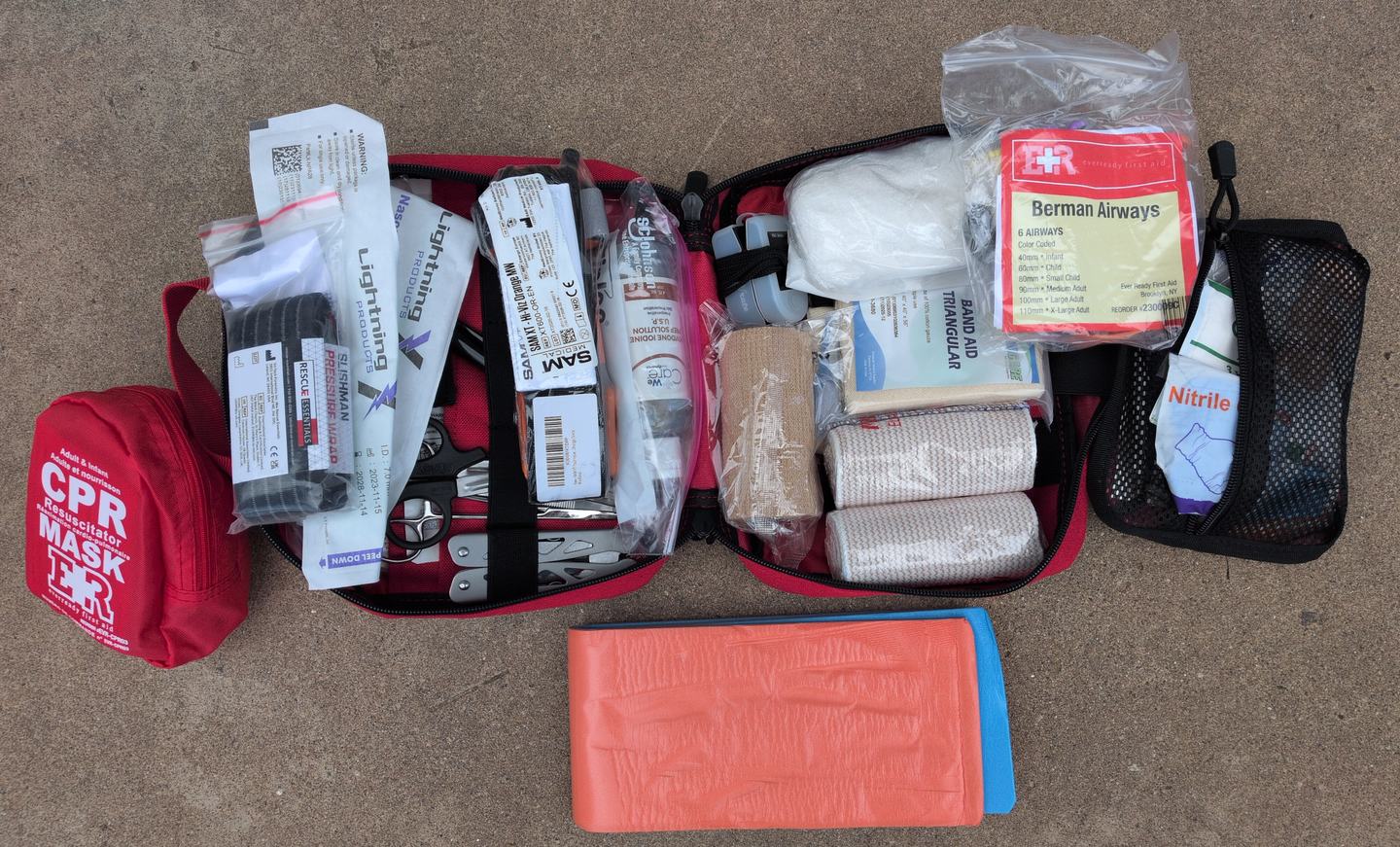
A kit you assembled yourself, sized for the trip you're actually taking.
What training doesn't do
Wilderness medicine doesn't make you a doctor, and the scope of practice documents are clear and careful about that on purpose. It doesn't give you the ability to fix everything you'll encounter, and part of what a good course teaches is recognizing the problems where the only real intervention is a fast evacuation.
It also doesn't replace the rest of your preparation. Skills don't call for help and they don't stop a bleed on their own, so you still need the supplies in your pack and a way to reach someone, whether that's a satellite messenger, a radio, or a plan that gets a runner to the trailhead.
Where TrekFreely fits
Your training helps whoever is with you. Your trip plan helps whoever comes for you.
When you build a trip in the trip portfolio, one of the sections is medical information: conditions, medications, allergies, blood type, etc. It's encrypted, and it isn't displayed to your emergency contacts. It's there for responders, for the case where you're the patient and can't answer questions. If you carry an epinephrine auto-injector or take a blood thinner, that's the kind of thing you want a paramedic to know without having to guess or dig through your pack.
The shared dashboard your contact opens also includes an emergency action plan, with the county sheriff and land agency numbers for the area you're actually in. That matters because the person at home reporting an incident is likely to be stressed in that moment, and giving them a phone number instead of a search box removes one more thing that can go wrong.
If you want a starting point for finding courses and studying between them, we keep a first aid and wilderness medicine section under Trainings in our Resources. We don't rank schools or push anyone's course, but we do focus on listing reputable ones. Compare what you're looking at against the published standards and pick the one you can get to.
The habit, not the card
Getting certified is the easy decision. You sign up, you show up, you're exhausted for a week, and you come out the other side capable of things you weren't capable of before. The hard part is the twenty-three months after that, when nothing is scheduled and nobody is testing you and the skills are quietly fading.
So put something on the calendar. One assessment a month on a patient volunteer. A kit audit at the start of the season. A re-cert booked before it expires. It's a small amount of work to keep, and the whole point is preparation for some future afternoon when you'll be the closest thing to help that somebody has, and you'll already know what to do with the next six hours.
References
The standards, hours, and research figures in this post come from these public sources. Standards and course requirements change, so check the current documents before relying on any detail.
-
Wilderness Medicine Education Collaborative, certification standards and minimum hours for WFA, WAFA, WFR, and WFR recertification. https://www.wildmededucationcollaborative.org/certification-standards.html
-
Wilderness Medicine Education Collaborative, "Certification Standards for Wilderness First Responder Courses" (March 2024). PDF
-
Wilderness Medicine Education Collaborative, "Importance of in-person hands-on learning in wilderness medicine" (2023). https://www.wildmededucationcollaborative.org/uploads/1/1/1/5/111560115/inperson.pdf
-
Hung EK, Townes DA, "Search and Rescue in Yosemite National Park: A 10-Year Review," Wilderness & Environmental Medicine (2007). https://journals.sagepub.com/doi/10.1580/06-WEME-OR-022R1.1
-
CSA Group, "First Aid Training and CPR Skills Retention," research review of adult resuscitation and basic life support training. https://www.csagroup.org/article/research/first-aid-training-and-cpr-skills-retention/
-
Anderson GS, Gaetz M, Masse J, "First aid skill retention of first responders within the workplace," Scandinavian Journal of Trauma, Resuscitation and Emergency Medicine (2011). https://sjtrem.biomedcentral.com/articles/10.1186/1757-7241-19-11
-
StatPearls, "Good Samaritan Laws," National Library of Medicine. https://www.ncbi.nlm.nih.gov/books/NBK542176/