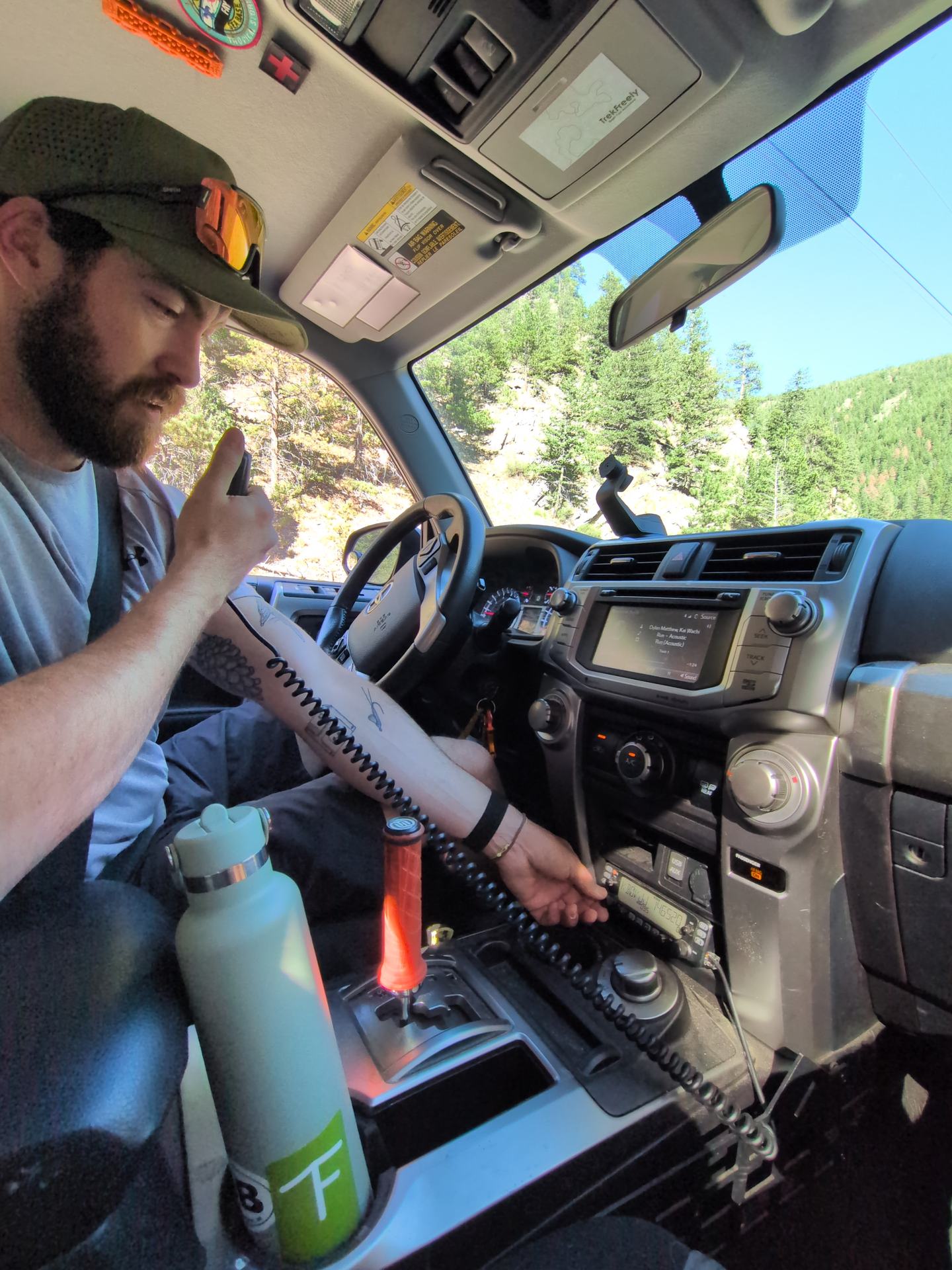
Say "backcountry radio" and most people picture the same two groups: preppers with a wall of gear, and off-road convoys talking truck to truck. Useful for them, sure, but not something a regular hiker or climber needs. That reputation is doing real harm, because a radio is one of the most useful safety tools you can carry, and it keeps working in the exact places your phone gives up.
This post is about closing that gap. We'll walk through the three services most people run into, FRS, GMRS, and HAM radio, what each is good for and what it costs to get into, and how amateur radio in particular can reach help when there's no cell signal for miles. None of it requires becoming a hobbyist. It just requires knowing what the tool does before you need it.
Why a radio belongs in your pack
Your phone depends on a tower. Step far enough from one, which in the backcountry is most of the time, and it's a camera. A radio doesn't work that way. It talks directly to other radios, and with a repeater it can reach across a mountain range, all with no cell network, no subscription, and no monthly bill. That's the whole appeal: it's a communication layer that runs on physics and a battery instead of infrastructure.
Let's start with the everyday reason, because it's the one that actually gets a radio into your pack. Most of the time you're not calling for rescue. You're telling the rest of your group you're taking the left fork, or asking the lead truck to slow down, or letting your ski partner know they're clear to drop into the fresh powder for some turns. A radio turns all of that from shouting and guessing into a quick, clear voice call, in places where a text will never send. Whether it's two climbers a pitch apart or a group that splits at a junction to regroup at the saddle, everyone stays on the same page.
That ease of use and communication is the whole point, and it's why radios have quietly gone mainstream with climbers, skiers, and hikers who are nobody's idea of a prepper. Companies like Rocky Talkie have built a following making small, rugged, glove-friendly radios aimed right at that crowd, because the coordination problem is universal. The bonus is that the radio you carry for convenience is the same one in your hand when a plan falls apart.
The bigger reason is the one people miss. With the right service and a little knowledge, a radio can reach help when nothing else can. That's not a prepper fantasy. It's a documented, everyday backstop that volunteers run across whole states, and we'll get to exactly how it works.
A radio runs on physics and a battery, not on a cell tower you can't reach.
The three services, and what each is for
Radio for the public in the US comes in three flavors. They differ in power, range, and what you're allowed to do without a license.
FRS: the no-license starting point
FRS, the Family Radio Service, is the walkie-talkie you already know. The bubble-pack radios at any outdoor store are FRS, they need no license, and anyone can use them. They're limited to two watts, so real-world range is often less than a mile in the trees and a few miles with a clear line of sight. That's fine for keeping a group together on a trail or around camp, which is exactly what they're for. Simple, free, and good enough for the most common job.
GMRS: more range, a trivial license
GMRS, the General Mobile Radio Service, shares some channels with FRS but allows far more: up to fifty watts, better antennas, and access to repeaters that extend your range dramatically. The catch is a license, and this is where people bail out unnecessarily. The GMRS license costs 35 dollars for ten years, requires no test of any kind, and covers your entire immediate family under one call sign. You fill out a form, pay online, and you're done, usually within a day.
For most backcountry adventurers, GMRS is the sweet spot. It's a real step up in range and capability over FRS, the radios are widely available and easy to use, and the license is about as low a barrier as a license can be. If you want more reach than a bubble-pack radio without learning a new hobby, this is the one.
HAM radio: the most capable, and the most rewarding
Amateur radio, or "HAM", is the deep end, and it's more approachable than its reputation suggests. It requires a license with an exam, but the entry-level Technician license is a straightforward multiple-choice test drawn from a public question pool, and plenty of people study for it in a weekend. What you get in return is the most capable service by far: more frequencies, more power, and access to a huge network of repeaters, including the linked systems that make long-distance backcountry contact possible.
HAM is also where the emergency-communication world lives. When a disaster takes down cell and power, amateur operators are often the ones still passing traffic, and that same infrastructure is standing by for a lost or injured person in the mountains. If you spend serious time in the backcountry and are willing to learn a little, a Technician license and a capable handheld open doors the other services can't.
When a radio is the only thing that can reach help
Across the country, volunteer amateur operators monitor repeater systems that blanket huge areas, including terrain where cell coverage simply doesn't exist. If you can reach one of those repeaters with a handheld, you can reach a person, and that person can get you help.
Colorado is a good example. The Colorado Connection is a statewide network of linked amateur repeaters that covers roughly 60 percent of the state, reaching deep into rural and wilderness areas where phones are useless. The Colorado Emergency Reporting Network, or CERN, rides on top of it: a group of volunteer operators who monitor the system 24 hours a day, 7 days a week. If you call in an emergency and can't reach 911 yourself, a CERN volunteer relays your information to 911 on your behalf and stays with you on the radio until help is coordinated. It's a staffed, always-on safety net running quietly over the mountains, and it exists in some form in many states.
There's even an established habit for reaching other operators when you're deep in the backcountry, sometimes called the wilderness protocol: operators in remote areas listen on the national calling frequencies, like 146.52 MHz, for a few minutes at the top of the hour so a person in trouble has a predictable window to raise someone. A HAM on a peak with a repeater in reach can relay for a HAM down in a drainage who can't.
None of this replaces a satellite messenger, and we wouldn't frame it that way. A dedicated device like a Garmin inReach reaches a monitoring center with the press of a button, which radio can't match for simplicity in a crisis. But radio does something a satellite messenger doesn't: it's a live, two-way voice link to real people that works for everyday communication and can still reach help when it counts. The two complement each other. If you carry a messenger, a radio is a strong second layer. If you're not ready to buy a messenger yet, a radio is a serious first one.
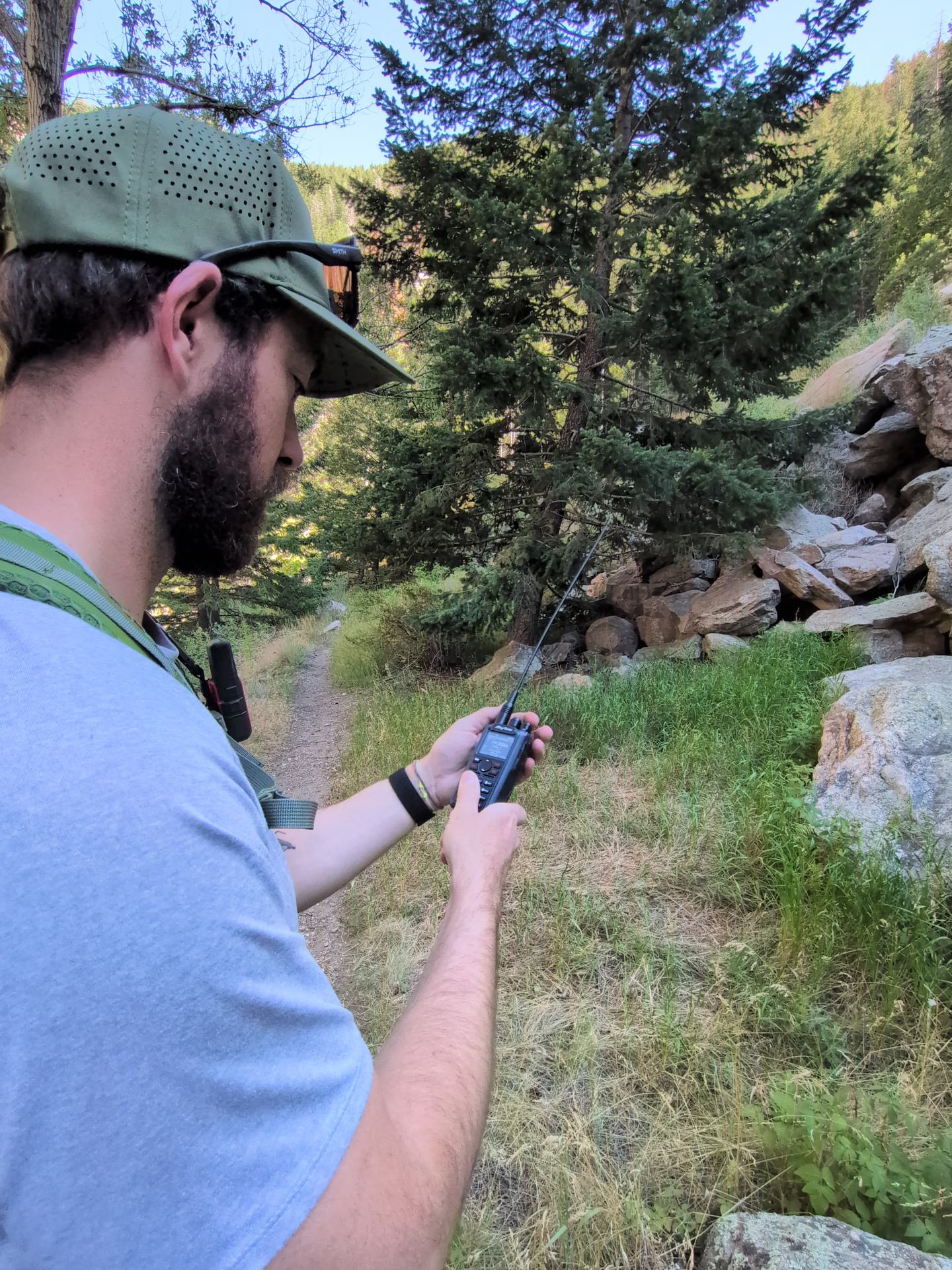
An AnyTone multi-band radio being used to check in during a backcountry trip.
One rule everyone should know: the emergency exception
Licensing matters, and you should get the right one for how you'll use a radio day to day. But there's a rule worth carrying in your head for the worst case. Under FCC rules, in a genuine emergency involving immediate danger to life or property, you may use a radio by any means at your disposal to call for help, even on frequencies or with equipment you're not normally licensed for. The license structure is about routine use. When a life is on the line, the rule is get the call out. Knowing that removes the last excuse for hesitating.
APRS and the trip portfolio
One more piece ties radio back to what we build. APRS, the Automatic Packet Reporting System, is a way for amateur radio to send small bits of data, most commonly a position. A radio with APRS beacons your location over the air, and that position can be picked up and mapped, which makes it a natural fit for keeping the people at home in the loop.
We've built that into the shared dashboard for every trip you go on. APRS position tracking now feeds directly into your TrekFreely trip portfolio, alongside the live tracking we already support from Garmin inReach and SPOT. If you run APRS, your position shows up on the same shared page your emergency contact is watching, next to your route and your plan. We use APRS here strictly for location tracking, not a check-in, and not a two-way SOS. It simply shows where you are, which is exactly what the person at home wants to see, but it isn't a substitute for a messaging device when you need to say what's wrong.
Where to start
You don't have to pick one and commit forever. A reasonable path for most people looks like this. If you just want your group to stay in contact on the trail, a pair of FRS radios costs almost nothing and needs no paperwork. If you want real range and the option of repeaters without a big time investment, get a GMRS license and a capable handheld, which covers most backcountry needs well. And if the emergency-communication side speaks to you, or you simply enjoy learning how it all works, a Technician license is your first step into the full amateur world, including the repeater networks and APRS.
Whatever you choose, the pattern is the same as any safety tool: get it before you need it, learn to use it at home, and carry it charged. A radio in the truck does nothing for you on the ridge.
We've pulled together the specifics, frequencies, license links, repeater directories, and how to get started, in the radio section of our Resources page. It's the place to go deeper once you know which service fits.
The point
Radio isn't a niche hobby you have to adopt or a prepper's stockpile you have to justify. It's a practical, affordable communication layer that works where your phone can't, keeps a group together, and, with a little knowledge, can reach a real person who will get you help when you have no other way to call. That's not fringe. That's just being ready.
If you already carry a satellite messenger, add a radio as your second layer. If you don't, start with a radio and build from there. Either way, you'll have closed one more gap between you and help. For the full picture on satellite devices, see our previous post on satellite messengers and PLBs.
References
The license rules, fees, and network details in this post come from these public sources. Rules and fees change, so check the official pages before relying on any detail.
-
FCC, General Mobile Radio Service (GMRS): rules, licensing, and the $35 / 10-year fee. https://www.fcc.gov/general-mobile-radio-service-gmrs
-
FCC, Family Radio Service (FRS): license-free use and power limits. https://www.fcc.gov/wireless/bureau-divisions/mobility-division/family-radio-service-frs
-
FCC, Amateur Radio Service: licensing and the Technician exam. https://www.fcc.gov/wireless/bureau-divisions/mobility-division/amateur-radio-service
-
ARRL, getting licensed and the Technician license question pool. https://www.arrl.org/getting-licensed
-
FCC emergency communications exception, 47 CFR 97.403 (amateur) and the general provision for using any means to call for help in an emergency. https://www.ecfr.gov/current/title-47/chapter-I/subchapter-D/part-97
-
Colorado Emergency Reporting Network (CERN) and the Colorado Connection statewide linked repeater system. https://co-cern.org/ and https://www.colcon.org/
-
APRS overview (Automatic Packet Reporting System). http://www.aprs.org/